Most adults learn about money the hard way - through mistakes, debt, missed opportunities, and the slow realisation that nobody ever taught them the basics. The credit card that got out of hand. The savings habit that never formed. The investment they didn't understand but made anyway. The financial anxiety that quietly shapes every major life decision.
It doesn't have to be this way. Research on financial behaviour is unambiguous: the habits and attitudes towards money that define adult financial wellbeing are largely formed in childhood. And children who receive structured financial education before the age of 12 develop fundamentally different - and measurably better - financial outcomes as adults.
The question for parents and schools isn't whether financial literacy matters. It is why we wait so long to teach it.
Why Childhood Is the Critical Window
The brain undergoes its most significant development in the early years of life, and the habits, beliefs, and mental frameworks formed during this period are extraordinarily persistent. Financial behaviours are no different. Research from Cambridge University found that money habits in children are formed by age seven - meaning that many of the attitudes a child will carry into adulthood about saving, spending, risk, and delayed gratification are already being shaped in early primary school.
This doesn't mean that financial habits can't change later in life. They can. But the effort required to change deeply embedded habits as an adult is substantially greater than the effort required to form good habits in the first place. Teaching a child to save before they have developed a spending habit is dramatically easier than teaching an adult to save after decades of the opposite.
"The goal of early financial education is not to turn children into miniature accountants. It is to give them a relationship with money that is characterised by awareness, intention, and confidence rather than anxiety, avoidance, and impulsivity."
What the Research Shows About Long-Term Outcomes
The evidence on early financial education is extensive and consistent. Children who receive structured financial literacy education are more likely to save regularly as adults, more likely to invest, less likely to carry high-interest debt, and significantly less likely to experience financial stress. They make better decisions at major financial decision points - buying a home, choosing insurance, planning for retirement - because they have a conceptual framework for evaluating those decisions rather than making them by instinct or default.
In the Malaysian context, where household debt levels remain a significant concern and financial stress affects a substantial proportion of working adults, the stakes of this education are particularly high. A generation that grows up financially literate is a generation that is less vulnerable to predatory lending, more capable of building long-term wealth, and better equipped to navigate an increasingly complex financial landscape.
Age 7
when core money habits begin forming in children
3×
more likely to save regularly if taught financial basics early
40%
lower likelihood of high-interest debt among financially literate adults
What Financial Literacy for Children Actually Involves
Financial literacy for children is not about teaching them to read a balance sheet or understand compound interest - at least, not initially. At its core, early financial education is about developing four capacities that will underpin everything else:
- Understanding the value of money - that money represents work, that it is finite, and that how it is used involves trade-offs.
- The habit of saving - the ability to defer gratification, to set a goal and work systematically towards it, and to feel the satisfaction of reaching it.
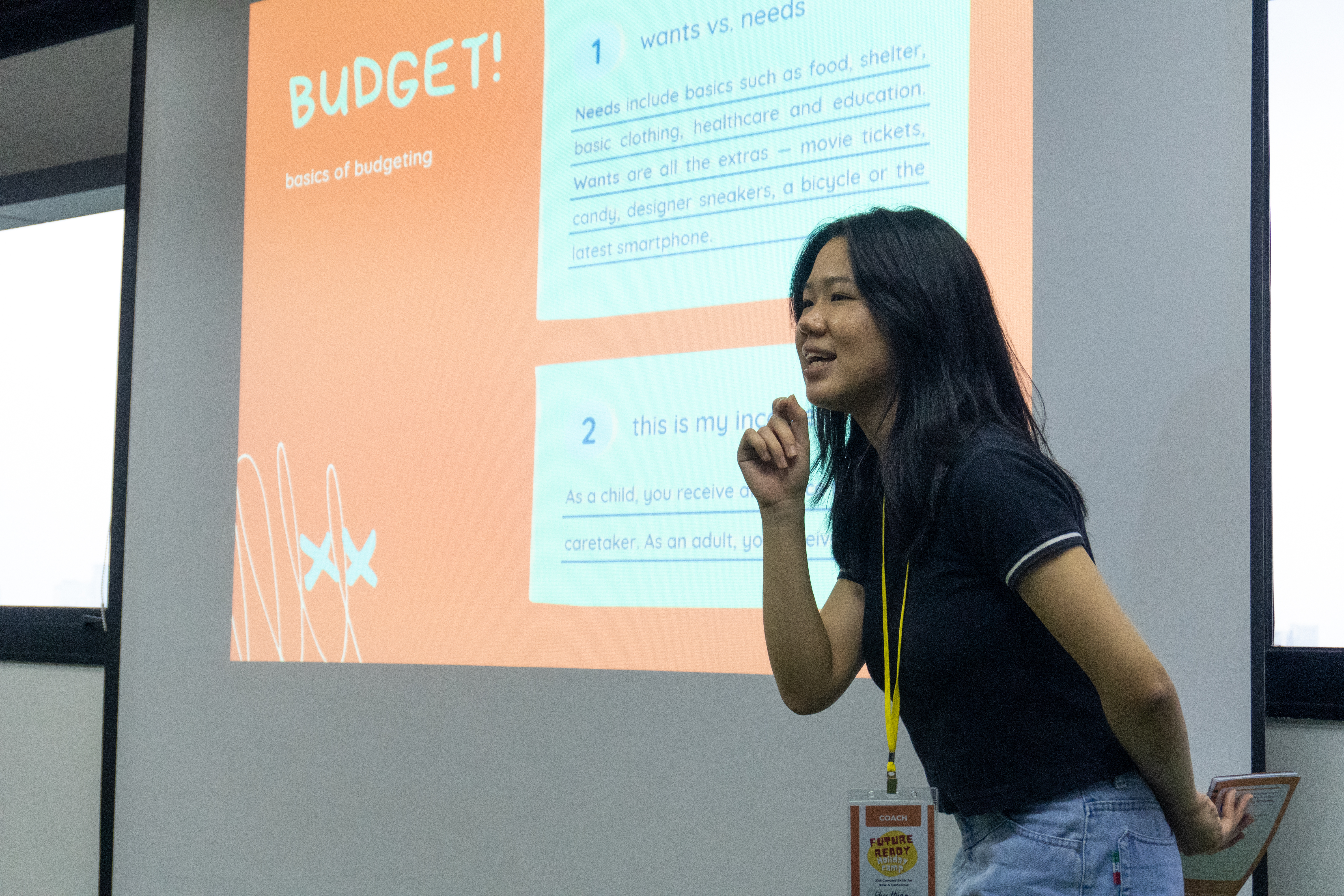
- Distinguishing needs from wants - one of the most fundamental and most frequently underdeveloped financial skills in adults.
- Basic decision-making under constraint - understanding that every financial choice involves giving something up, and developing the habit of thinking before spending.
These concepts can be introduced in age-appropriate ways from as young as five or six. By the time a child reaches secondary school, a solid foundation in these areas enables engagement with more sophisticated concepts: budgeting, interest and compound growth, investment basics, and the principles of financial risk.
The Role of Schools and Parents
Financial literacy is most effective when it is reinforced from multiple directions - school, home, and real-world experience working together rather than in isolation.
At home, the most powerful thing parents can do is make money visible. Talk about financial decisions in age-appropriate ways. Give children real money to manage - pocket money with real choices attached - rather than shielding them from financial reality. Allow them to experience the consequences of their choices in a safe, low-stakes environment before those choices have real financial significance.
At school, financial literacy works best as a structured programme with clear learning objectives, engaging delivery, and real-world application. Abstract instruction about money doesn't work. Simulation, games, decision-making exercises, and real examples that connect financial concepts to a child's lived experience - these are the approaches that build genuine understanding rather than surface familiarity.
Why This Is Urgent
The financial environment that today's children will navigate as adults is considerably more complex than the one their parents faced. Digital payments have made money invisible, removing the visceral awareness of spending that physical cash creates. Buy-now-pay-later products are proliferating and are specifically designed to reduce the psychological friction of spending. Investment products are more accessible but also more complex and more risky than ever before.
In this environment, financial literacy is not a nice-to-have. It is a protective factor - a form of practical intelligence that will determine whether a young person enters adulthood equipped to build financial security or vulnerable to the many systems that will try to separate them from their money.
The earlier that protection is in place, the stronger it is. And the earlier financial education begins, the more time good habits have to compound into the behaviours that define a financially secure and confident adult life.
Starting Today
If you are a parent wondering where to begin, start with conversations. Ask your child what they would do if they had a small amount of money. Talk about the difference between things we need and things we want. Give them a simple savings goal and help them work towards it. The sophistication of the content matters far less than the consistency of the habit.
If you are a school administrator, ask honestly whether your current curriculum - academic and co-curricular - gives students the financial knowledge they will need as adults. If the answer is no, or if what exists is superficial, the solution is a structured programme delivered by people who understand both finance and how to make it genuinely engaging for young people.
The children in your school or your home will make thousands of financial decisions over the course of their lives. The foundation for those decisions is being laid right now. It is worth taking seriously.